

Table of Contents
- What Is Hemp Fabric and Why It Matters for Garment Making
- Environmental Benefits and Sustainability of Hemp Textiles
- How to Sew with Hemp Fabric: Techniques and Best Practices
- Hemp and Organic Cotton Blends for Improved Hand-Feel
- Hemp Fabric Care Instructions for Long-Lasting Garments
- Sourcing Ethical Hemp: Supply Chain Transparency and Certification
- Durability, Biodegradability, and the Circular Economy Impact
- Frequently Asked Questions
Last Updated: September 21, 2026
What Is Hemp Fabric and Why It Matters for Garment Making
Sustainable hemp fabric for garment making is a natural fiber textile derived from the Cannabis sativa plant, engineered to deliver durability, breathability, and environmental responsibility in equal measure. Unlike synthetic alternatives, hemp requires no pesticides to grow and regenerates soil quality for subsequent crops, making it a cornerstone material for eco-conscious makers.
The global hemp clothing market reached USD 6.80 billion in 2026, up from USD 6.16 billion in 2025, according to Hemp Clothing Global Forecast Report. This growth reflects a fundamental shift: sewing enthusiasts and small garment makers are prioritizing sustainable hemp fabric for garment making because it delivers both aesthetic and environmental wins without compromise.
Hemp's bast fiber structure produces textiles with exceptional tensile strength; a single garment can outlast three cotton equivalents, meaning fewer replacements and less landfill waste.
Environmental Benefits and Sustainability of Hemp Textiles
Hemp cultivation regenerates soil while consuming one-third the water required by conventional cotton, according to Textile School. Farmers rotating crops with hemp have observed a 10-20% increase in subsequent yields for other crops, creating a genuine circular-economy benefit that extends beyond the garment itself.
Hemp processing requires minimal intervention, primarily water retting and mechanical separation, producing fewer toxic effluents than cotton's chemical-intensive protocols.
Biodegradability is hemp's hidden advantage. Unlike synthetic fabrics that persist in landfills for decades, hemp textiles break down completely within 5-6 months of composting. This end-of-life profile matters for makers building sustainable brands: a garment made from sustainable hemp fabric for garment making can be marketed as fully circular, with zero persistent waste.
According to Market Research Future, the hemp fabric industry is projected to grow from USD 6.3 billion in 2025 to USD 16.8 billion by 2035, representing a 10% compound annual growth rate. This trajectory reflects genuine market demand, not marketing hype. Brands and makers aren't adopting hemp for optics, they're adopting it because the material delivers on both performance and sustainability metrics.
How to Sew with Hemp Fabric: Techniques and Best Practices
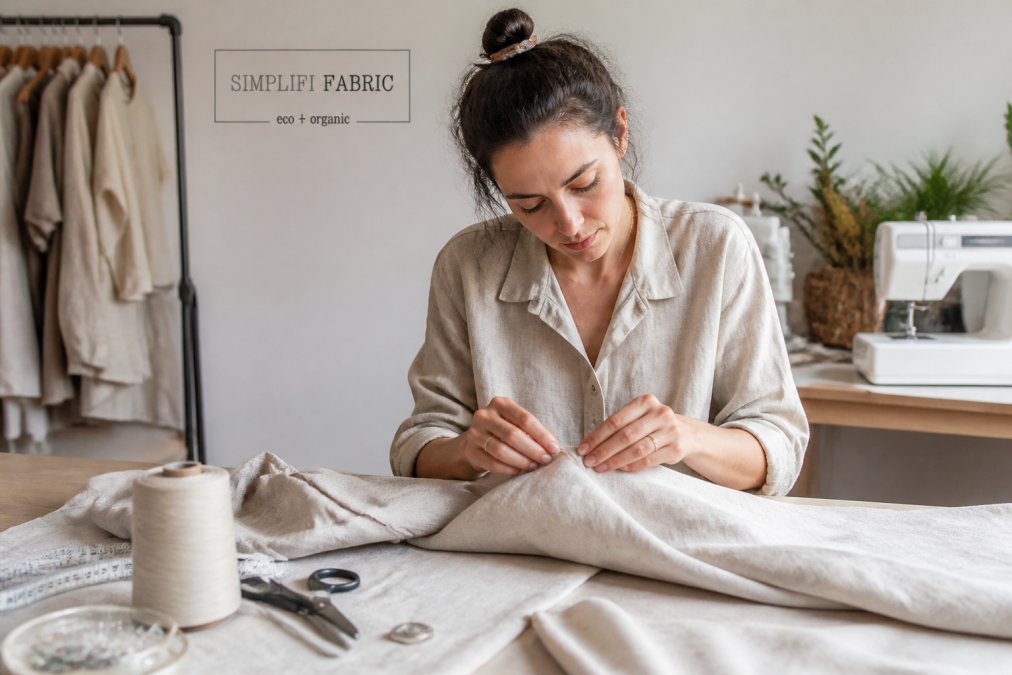
Hemp's density requires higher thread tension and larger needles (80/12 or 90/14 instead of standard 70/10); undersized needles cause skipped stitches and thread shredding.
Pre-wash in cool water and dry flat; hemp shrinks 3-5%, so account for this before cutting to prevent unexpected shifting after the wearer's first wash.
Use French or flat-felled seams to reduce bulk at necklines and armholes while reinforcing seams against hemp's natural stiffness.
Topstitching adds durability and visual interest; a 0.6 cm topstitch around necklines and cuffs reinforces high-stress areas.
Hemp and Organic Cotton Blends for Improved Hand-Feel
Hemp-cotton blends soften hand-feel while preserving durability and environmental benefits; the ratio determines performance and construction difficulty.
Common blend ratios and their characteristics:
50/50 hemp-to-cotton blends offer balanced drape, softer hand-feel, 2-3% shrinkage, and moderate sewing difficulty (80/12 needles, minimal tension adjustment), ideal for first-time hemp users.
70/30 hemp-to-cotton blends maximize durability and water savings for structured garments, with 3-4% shrinkage and higher sewing difficulty (80/12 or 90/14 needles, elevated tension).
30/70 hemp-to-cotton blends prioritize ease of sewing (standard 70/10 needles, conventional tension) and drape, with 1-2% shrinkage, suited for beginners and lightweight garments, though environmental benefit is marginal.
Organic cotton in blends matters critically. Conventional cotton uses 16% of global pesticides despite occupying only 2.5% of cultivated land. Blending organic cotton with hemp ensures the finished garment contains zero synthetic residues, a non-negotiable consideration for makers marketing to health-conscious consumers or for garments worn against sensitive skin. Always verify that the cotton component is GOTS-certified organic; some suppliers label blends as "sustainable" while using conventionally grown cotton, which undermines both environmental and health claims.
Hemp-Tencel blends (50/50) offer exceptional softness and drape with straightforward sewing, but higher cost and reduced environmental benefit due to chemical processing.
Blend selection: Choose 50/50 for first-time hemp users and balanced drape. Choose 70/30 for maximum durability. Choose 30/70 for beginners and lightweight garments. Choose hemp-Tencel for premium markets.
Hemp Fabric Care Instructions for Long-Lasting Garments
Use cool water, mild detergent, and gentle cycles; hot water and harsh detergents degrade hemp's protective oils.
Dry flat or hang-dry; if machine drying is necessary, use lowest heat and remove while damp.
Iron at low to medium heat with steam to avoid flattening texture and damaging fibers.
Store in cool, dark spaces using breathable cotton bags; use cedar or lavender to deter insects.
Spot-clean with cool water and mild soap; avoid all bleach.
A well-maintained hemp garment gains character with age. The fabric softens slightly, colors deepen, and the wearer's body imprints on the fit. This aging process is a feature of natural fibers, not a flaw, and it's precisely why sustainable hemp fabric for garment making appeals to makers building heirloom-quality pieces.
Sourcing Ethical Hemp: Supply Chain Transparency and Certification
Certification alone is insufficient; develop a vetting framework that goes beyond checkbox compliance to ensure transparency and fair labor practices.
Certifications to prioritize:
- GOTS (Global Organic Textile Standard): Covers fiber production, processing, and labor practices. Verify current certification at gots.org rather than relying on supplier claims.
- Fair Trade Certified: Ensures farmer compensation meets living-wage standards and that a portion of proceeds funds community development. Fair Trade hemp is less common than GOTS-certified fiber but signals commitment to farmer welfare beyond environmental metrics.
- OEKO-TEX Standard 100: Verifies the finished textile contains no harmful substances, including heavy metals, formaldehyde, and restricted dyes. This certification matters for garments worn against skin, particularly for makers marketing to consumers with chemical sensitivities.
- Cradle to Cradle: Assesses environmental impact across the entire product lifecycle, from fiber cultivation through processing and end-of-life. Cradle to Cradle certification is rigorous and expensive, so it's less common in hemp textiles, but it signals a supplier's commitment to circular-economy principles.
Supplier transparency framework:
Use this checklist to evaluate supplier transparency:
- Geographic sourcing: Can the supplier name specific regions or farms? Vague answers suggest limited traceability.
- Processing methods: Does the supplier explain fiber extraction and water treatment systems?
- Labor practices: Does the supplier disclose worker compensation and working conditions?
- Batch traceability: Can the supplier trace fabric back to the farm where hemp was grown?
- Third-party audits: Has the supplier undergone independent environmental or labor audits?
Red flags that indicate a supply chain worth avoiding:
- Supplier refuses to name fiber origin or claims "proprietary sourcing" without explanation.
- Certifications are mentioned but not verifiable (check GOTS, Fair Trade, and OEKO-TEX directories directly).
- Pricing is suspiciously low (below market rate for certified fiber), suggesting corners are cut somewhere in the supply chain.
- Supplier cannot explain processing methods or deflects with marketing language ("eco-friendly processing") rather than technical detail.
- No documentation available for batch-level traceability; supplier sells only in bulk without lot numbers or origin information.
- Supplier has no public information about labor practices, worker compensation, or community relationships.
Evaluating small-scale versus commodity suppliers:
Small-scale producers often offer superior transparency. Boutique hemp suppliers maintain direct relationships with farmers and processors, allowing them to guarantee fiber quality and ethical practices in ways that commodity suppliers cannot. However, small-scale suppliers typically have higher minimum order quantities (often 50+ yards) and longer lead times. Indie sewing communities find their most reliable materials through boutique suppliers, even when cost is higher.
Commodity suppliers offer lower prices and faster delivery but rarely provide batch-level traceability or detailed supply-chain information.
- Where is the hemp grown, and can you provide the farm name or region?
- Which certifications apply to this specific fabric, and can you provide current certificates?
- What water treatment systems are used in processing, and are effluents tested?
- How are workers compensated, and what are working conditions like in processing facilities?
- Can you trace this fabric back to the farm where the hemp was grown?
- What is your minimum order quantity, and do you offer smaller test quantities?
- How long is the typical lead time from order to delivery?
- Do you have a sustainability or impact report available?
Durability, Biodegradability, and the Circular Economy Impact
Hemp garments outlast cotton equivalents by a factor of three or more. A hemp t-shirt worn weekly will maintain structural integrity and color for 5-7 years, while a comparable cotton shirt typically shows visible degradation within 2-3 years. This durability gap compounds: a maker producing 50 hemp garments annually generates roughly 75 fewer replacements over a decade compared to cotton-equivalent production.
Frequently Asked Questions
Is hemp fabric environmentally friendly for garment making?
Yes. Hemp requires approximately one-third of the water used by conventional cotton to produce equivalent fiber yields, and it grows without pesticides. The global hemp clothing market reached USD 6.80 billion in 2026, driven by demand for sustainable alternatives. Hemp is fully biodegradable, supporting circular fashion goals and reducing textile waste in landfills.
What are the common challenges when sewing with hemp fabric?
Hemp can feel scratchy or stiff initially, requiring significant washing or softening before use in comfortable apparel. The bast fiber structure means hemp requires sharp needles and steady tension settings. Beginners may find the fabric less forgiving than cotton, but proper technique and appropriate needle selection resolve most issues.
How do hemp and organic cotton blends compare to pure hemp?
Blends improve hand-feel and drape while retaining hemp's durability and sustainability benefits. A 55% hemp and 45% organic cotton mix offers breathability and moisture-wicking without the initial stiffness of 100% hemp. Blends are ideal for garments worn close to skin, while pure hemp suits structured pieces and outerwear.
How should I care for hemp garments to ensure longevity?
Wash hemp in cool water with mild detergent and air dry to preserve fiber integrity. Hemp naturally resists odor due to its antibacterial properties, so garments require fewer washes than conventional cotton. Avoid high heat and bleach. Proper care extends garment lifespan significantly, reducing overall environmental impact.
For those looking to create durable, sustainable garments, Simplifi Fabric offers a range of high-quality hemp textiles. Explore our collection at https://www.simplififabric.com to find the perfect material for your next eco-conscious project.