

Quick Summary
Digital sewing patterns are usually worth it when you sew occasionally and have a home printer or access to a copy shop. Their lower sticker price can be offset by printing, paper, shipping and assembly time, so compare the full total before you buy.
- Simplifi Fabric PDF patterns are listed from $17.00 to $23.00 CAD and arrive by email.
- Compare total cost: pattern price, printing, shipping, paper and ink, and assembly time.
- Print only the size range you need, and test-print one page to confirm the scale.
- Tape pattern pages in the layout order and check a test square before cutting.
- Save the digital file so you can reprint pages instead of losing the pattern.
Table of Contents
- What Digital Sewing Patterns Actually Cost Once You Add It Up
- PDF Sewing Patterns vs Paper Patterns: Where the Money Goes
- How to Print PDF Sewing Patterns Without Wasting Paper
- How to Assemble a PDF Sewing Pattern Step by Step
- Time, Storage and Reprints: The Costs Nobody Lists
- Digital Sewing Patterns for Beginners: Are They Worth It?
- Choosing Your Next Pattern: Which Option Fits Your Sewing Habits
- Frequently Asked Questions
Are Digital Sewing Patterns Worth the Cost? A Practical Look
Last Updated: November 14, 2026
Digital sewing patterns often look cheaper than paper patterns at checkout, but the real cost depends on printing, assembly, shipping and your time. Simplifi Fabric carries a curated range of indie PDF patterns, and this guide walks through what a digital pattern really costs so you can decide whether it suits how you sew.
Digital sewing patterns are sewing patterns delivered as PDF files that you print at home or at a copy shop and assemble before cutting. The price tag is only the start. Every printed sheet, every tiled page and every reprint adds to the total.
What Digital Sewing Patterns Actually Cost Once You Add It Up
The sticker price is the easiest number to compare, and it is often the least complete one. The total also reflects the work behind a pattern, since drafting, testing, and clear instructions all shape what a maker pays; Things Fabric explores the same question through quilting patterns.
To compare fairly, build a like-for-like total for each format: pattern price, printing cost, shipping, paper and ink, and the value you place on assembly time. The table below shows the cost buckets to fill in for your own situation. Use current prices from your printer or local copy shop, and be honest about how long taping takes you.
| Cost bucket | Home-printed PDF | Copy-shop PDF | Mailed paper pattern |
|---|---|---|---|
| Pattern price | $17.00-$23.00 CAD | $17.00-$23.00 CAD | Typically higher than PDF |
| Printing | Paper and ink at home | Per-sheet A0 or tiled rate | None |
| Shipping | $0.00 CAD (email) | $0.00 CAD if in person | Postal rate applies |
| Assembly time | Taping and trimming | Taping and trimming (unless A0) | None |
| Reprints | Pay paper and ink again | Pay per-sheet rate again | Pattern is single-use unless traced |
A full pattern can run to dozens of tiled pages, so a single home print run uses a meaningful amount of paper and ink.
A simple way to compare options is to total the pattern price, the printing cost and the value you place on your time, then compare that total with a printed pattern's price plus shipping. For occasional sewists, the difference is often small.
Watch out: comparing a PDF's sticker price with a paper pattern's sticker price ignores printing and shipping entirely, which is the most common way this calculation goes wrong.
PDF Sewing Patterns vs Paper Patterns: Where the Money Goes
PDF sewing patterns and paper patterns cost money in different places. A paper pattern has a higher upfront price and usually arrives by mail, but it needs no printing or taping. A PDF pattern has a lower purchase price, but its costs show up in paper, ink and assembly time.
The Bamberton Shorts pattern includes two size ranges and a projector-compatible file, so you can choose the format that suits your printer. That flexibility is a real benefit, but it comes with the work of selecting and printing only the pages you need.
If you have a home printer and enjoy the assembly, a digital pattern may suit you. If you prefer to start cutting right away, a paper pattern may feel worth the extra money.
How to Print PDF Sewing Patterns Without Wasting Paper
Printing is where most of the hidden cost sits, so a few habits make a difference. Print only the size layer you need. The Bamberton Shorts pattern, for example, lets you print just the smaller or larger size range rather than the full file.
Check the printer settings before you print the whole file. Print a single test page, and confirm that the test square measures the correct size. Use the scale setting that matches your paper, such as Letter or A4, so the pattern prints at true size. Printing at the wrong scale is one of the most common reasons a pattern fails to fit.
If you need large sheets, many copy shops can print an A0 file. Ask for the price per sheet first, then compare it with the cost of printing the same pages at home on standard paper.
Finally, avoid reprinting. Save the file on your computer and keep the printed pages flat and dry. A pattern you can reuse spreads its cost across several projects.
How to Assemble a PDF Sewing Pattern Step by Step
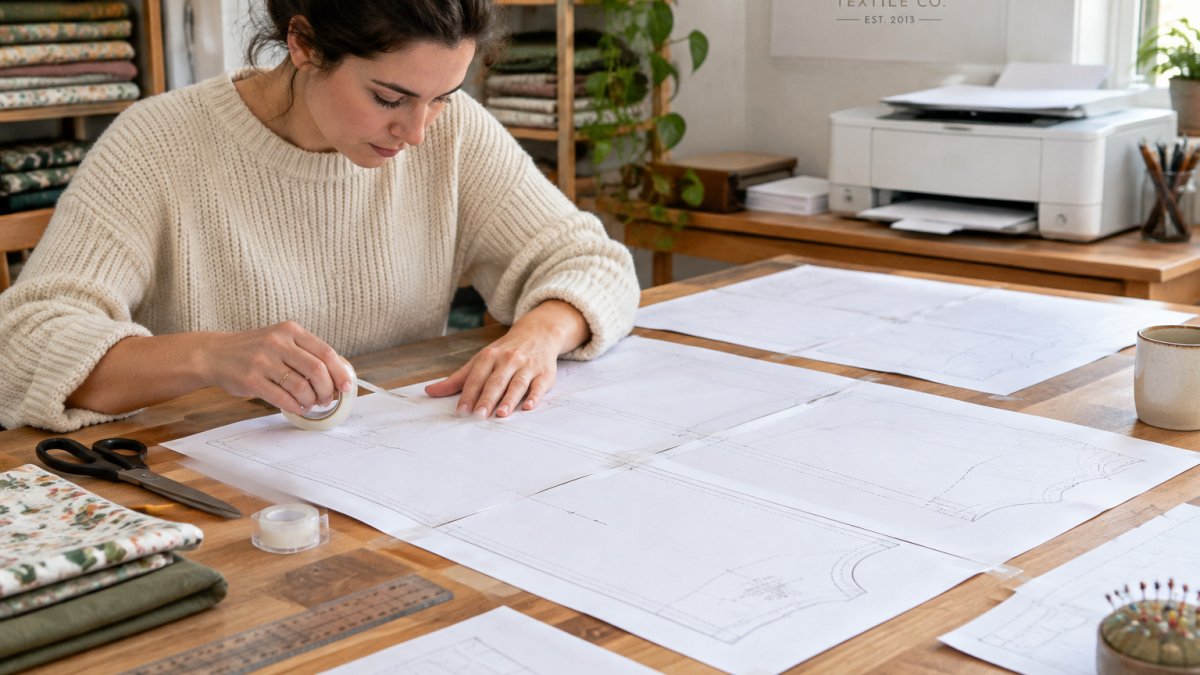
Assembly takes patience, but a clear method keeps it manageable. Start by reading the pattern's instructions and the layout guide, so you know how the pages fit together before you tape anything.
- Trim the margins. Cut along the outer border of each page, or along the marked line, to remove the printer margin.
- Sort the pages. Lay the pages out in the grid shown in the layout guide.
- Line up the edges. Match the registration marks at each corner, starting with the top row.
- Tape the seams. Apply clear tape along the back of each join, then flatten the tape with your fingers.
- Check the pattern. Measure a test square on the assembled sheet to confirm the scale.
- Trace or cut. Trace the pieces onto pattern paper, or cut directly from the taped sheet if it is sturdy enough.
Expect assembly to take a meaningful portion of an evening, especially for a multi-view pattern with many pieces. A short pattern with a handful of pages may take under an hour; a full multi-view garment with dozens of tiled pages can take several hours once trimming, taping and tracing are counted.
The practical constraints matter as much as the method. A home printer, a clear floor or table large enough to lay out the page grid, and comfortable vision and dexterity all affect how smoothly assembly goes. If you have limited workspace, tape in sections rather than laying out every page at once.
Watch out: taping pages in the wrong order or skipping the test-square check is the most common cause of a pattern that assembles neatly but fits poorly.
A simple decision framework helps. Occasional sewists with a home printer and a clear table usually find home assembly fine for short patterns. Frequent makers who sew multi-view garments may prefer A0 prints to cut assembly time. Beginners should start with a short pattern so the taping burden stays small while they learn.
Time, Storage and Reprints: The Costs Nobody Lists
The costs that catch people out are rarely the ones on the price tag. Assembly time is the largest. Taping dozens of pages and tracing pattern pieces can take longer than the sewing itself, and that time has a value even if you never write it down.
Storage is another cost. A folder of printed pages takes up room, and a loose sheet tears or fades if it is handled often. Many sewists keep the digital file as the master copy and print only when they start a project.
Reprints add to the bill. If you lose a page, print a damaged one, or want to make a second version, you pay for the paper and ink again. Saving the file and printing the pages you need, when you need them, keeps those costs predictable.
Backup matters too. Store the PDF in at least two places, such as your computer and a cloud folder, so a failed drive does not cost you the pattern you paid for. Read the licence terms that come with each pattern, since they set out what you may do with the files and the garments you make.
Digital Sewing Patterns for Beginners: Are They Worth It?
Beginners often wonder whether a digital pattern is a sensible first purchase. The answer depends on the pattern. Many digital patterns are rated for intermediate sewists, and the Betsy Utility Jacket and Rose Raglan Button Up patterns both list intermediate difficulty on their product pages. A simpler project makes a better starting point.
Beginners should look for clear written instructions and illustrations, and a pattern that includes a size chart that matches their measurements. The Bamberton Shorts pattern includes a detailed instruction booklet, which can help new sewists work through each step.
Starting small keeps the cost low. A single PDF pattern at $17.00 to $23.00 CAD is a modest investment, and printing a short pattern uses only a few sheets. If the first project goes well, the next purchase is an easy decision.
Choosing Your Next Pattern: Which Option Fits Your Sewing Habits
The right choice depends on how you sew. If you sew occasionally and own a home printer, a digital pattern is usually good value, especially when you want a specific size range or a style that is hard to find in print. If you sew constantly, consider how many reprints and pages you will go through over a year.
Think about the fabric and the fit too. A pattern with a large size range suits people who grade between sizes, while a pattern with fewer sizes suits those who sew a single fit. The Vera Dress and Top pattern from Ploen Patterns, at $19.00 CAD, includes multiple views, which may appeal if you enjoy varying a single base pattern.
Simplifi Fabric's PDF patterns are listed below, with starting prices in CAD:
| Pattern | Designer | Starting Price (CAD) | Best For |
|---|---|---|---|
| Betsy Utility Jacket | Lydia Naomi | $17.00 | Layered outerwear, intermediate sewists |
| Bamberton Shorts (Mens) | Thread Theory | $18.00 | Shorts with an expanded size range |
| Bamberton Shorts (Womens) | Thread Theory | $18.00 | Shorts with an expanded size range |
| Vera Dress and Top | Ploen Patterns | $19.00 | Multiple dress and top views |
| Rose Raglan Button Up | Paradise Patterns | $23.00 | Shirts and shirt-style garments |
Starting Price (CAD)
Once you have chosen a pattern, pair it with fabric suited to the design. Simplifi Fabric carries a range of organic and sustainable textiles, so you can match a pattern to a fabric that fits your project. For more on picking the right cloth, read How to Choose Sustainable Quilting Cotton before you buy.
Digital sewing patterns are worth the cost when the total, including printing and assembly time, fits your sewing habits. Add up the real costs first, then decide.
Frequently Asked Questions
Are digital sewing patterns worth the cost?
For most makers who sew regularly, yes, though the answer depends on how you count. A digital pattern is often a lower upfront purchase than a printed one. Against that, you pay for paper, ink and the time spent printing and taping. The Betsy Utility Jacket PDF Pattern from Simplifi Fabric is $17.00 CAD, and the Bamberton Shorts are $18.00 CAD. Add printing costs and your own assembly time, then compare that total with the price of a printed pattern from your usual supplier before deciding.
Are PDF sewing patterns cheaper than printed patterns?
The pattern itself is often cheaper, but the full cost depends on what you add. Home printing uses paper and ink, and a large-format file may be printed at a copy shop, which costs extra. Simplifi Fabric's digital patterns are listed from $17.00 CAD to $23.00 CAD, so compare each one's sticker price with what you would spend printing it in full, not just the first page count.
How do you choose the right size in a digital sewing pattern?
Start with the size chart in the pattern's instructions and measure yourself before printing anything. Some digital patterns, such as the Bamberton Shorts, include multiple size ranges and separate layers, so you print only the size you need. Check whether the file includes a grading option, since that lets you move between sizes more easily. If you are between sizes, a test square printed at the correct scale helps confirm the file printed at 100 per cent.
Are digital sewing patterns good for beginners?
They can be, but the difficulty level matters more than the format. Many digital patterns are marked intermediate, and the Betsy Utility Jacket is listed at that level. Beginners often benefit from patterns that include clear illustrated instructions and a video tutorial. Plan extra time for printing and taping, and consider a simpler project first so you can learn both the pattern format and the sewing techniques at the same time.
