

Table of Contents
- Why Sewers Are Looking Beyond HoneyBeGood
- Top Sustainable Sewing Alternatives for Ethical Fabric
- Eco Friendly Quilting Supplies Online: What to Look For
- GOTS Certified Fabric in Canada and Beyond
- Verifying Supply Chain Transparency and Ethical Sourcing
- Price Comparison: Sustainable vs. Conventional Fabric
- Beyond Fabric: Eco-Friendly Notions and Sewing Supplies
- Upcycling and Pre-Owned Textiles: The Most Ethical Option
- Frequently Asked Questions
Last Updated: October 4, 2026
Why Sewers Are Looking Beyond HoneyBeGood
Sewers committed to sustainable sewing alternatives are increasingly exploring options beyond single retailers. The global sustainable fabrics market is projected to reach USD 41.28 billion in 2026 (Svegea market analysis), signaling that eco-conscious makers have more choices than ever before. This guide from Simplifi Fabric examines the landscape of sustainable sewing alternatives, helping you find materials and supplies that align with your environmental values without compromising quality or creativity.
Evaluate options based on fabric certifications, ethical sourcing transparency, price-per-yard value, and supply chain accountability.
Top Sustainable Sewing Alternatives for Ethical Fabric
Organic Cotton and Natural Fiber Sources
Organic cotton remains the most accessible entry point for sustainable sewing. Unlike conventional cotton, which relies heavily on pesticides and synthetic fertilizers, organic cotton is grown without synthetic chemicals, reducing environmental impact and protecting soil health. According to Sewing Chanel Style's sustainable fabric guide, organic cotton ranks among the top established sustainable fabrics for 2026, alongside Tencel (Lyocell), hemp, linen, and recycled polyester.
Look for GOTS (Global Organic Textile Standard) certification, which independently verifies environmental and social criteria.
Linen and hemp require minimal pesticides and water, biodegrade completely at end-of-life, and offer exceptional durability for workwear and structured garments.
Hemp and Linen for Durable Apparel
Hemp and linen require sharper needles, proper tension, and careful seam finishing. Beginners should practice on smaller projects before committing to full garments.
| Fiber | Best For | Durability | Care Requirements |
|---|---|---|---|
| Organic Cotton | Everyday wear, quilting | Moderate | Standard washing |
| Hemp | Workwear, structured garments | Excellent | May soften with age |
| Linen | Warm-weather apparel, home goods | High | Wrinkles naturally |
Recycled Polyester and Regenerated Fibers
Recycled polyester transforms post-consumer plastic waste into usable textile fiber, diverting material from landfills while reducing demand for virgin petroleum-based production. According to Portugal Clothing Factory's sustainable guide, regenerated nylon (ECONYL) and agricultural waste yarns represent emerging innovations in the fashion supply chain for 2026.
Tencel (Lyocell), a regenerated cellulose fiber from sustainably managed forests, uses a closed-loop process recovering 99% of solvents and suits both garment making and quilting.
Eco Friendly Quilting Supplies Online: What to Look For
Sustainable quilting requires attention to batting, thread, and notions. Organic cotton or bamboo batting eliminates synthetics, while natural fiber thread biodegrades completely, preventing microplastic pollution.
Hardwood buttons and metal notions reduce petroleum dependency and last longer than plastic equivalents, reducing replacement frequency.
When evaluating eco friendly quilting supplies online, verify GOTS certification and request supply chain transparency reports detailing fabric origins, manufacturing locations, and labor practices.
GOTS Certified Fabric in Canada and Beyond
Global Organic Textile Standard (GOTS) certification represents the gold standard for organic fiber verification, applying equally across all manufacturing regions. GOTS-certified organic cotton often outlasts conventional fabric through more wash cycles, reducing cost-per-wear over a garment's lifetime.
Verifying Supply Chain Transparency and Ethical Sourcing
Supply chain transparency separates genuine sustainable sewing alternatives from greenwashing. Reputable suppliers publish detailed information about fabric origins, manufacturing facilities, labour practices, and environmental impact metrics.
The Verification Checklist: What to Request and How to Evaluate
When evaluating a supplier's sustainability claims, request specific documentation:
1. Fiber Origin and Growing Practices
- Request: Specific countries/regions where raw fiber is grown; pesticide/fertilizer use data; water consumption per kilogram of fiber.
- Red flags: Vague answers; refusal to name suppliers; claims of "organic" without certification.
- Green signals: Named farms or cooperatives; third-party audit reports; water usage metrics.
2. Manufacturing Facilities and Labour Standards
- Request: Facility names and locations; worker wage data; certification from labour-standards bodies (Fair Trade, SA8000, or equivalent).
- Red flags: Refusal to name facilities; vague "fair wages" claims; facilities without independent audits.
- Green signals: Published facility lists with audit dates; wage transparency; third-party labour audits.
3. Environmental Impact Metrics
- Request: Wastewater treatment methods; chemical use restrictions; carbon footprint per metre; certifications (GOTS, Cradle to Cradle, B-Corp).
- Red flags: No data available; "eco-friendly" claims without standards; refusal to disclose chemical use.
- Green signals: Published environmental reports; third-party certifications; specific metrics.
Red Flags That Signal Greenwashing
Red flags indicating greenwashing include: unsubstantiated claims without certification; vague sourcing without named suppliers; missing third-party verification; inconsistent messaging between marketing and practices; no price premium; and refusal to answer direct questions.
How to Verify Certifications Independently
Don't take supplier claims about certifications at face value. Verify them:
GOTS (Global Organic Textile Standard): Visit GOTS certified facilities database. Search by facility name or supplier. Legitimate GOTS fabric includes a license number; cross-reference it on the official registry.
Fair Trade Certification: Check Fair Trade International directory. Verify that the supplier or facility appears in their certified producer database.
B-Corp Certification: B-Corp directory lists all certified companies. Search by name; legitimate B-Corps display their certification date and impact score.
ZW Bell Jacket - Birgitta Helmersson - PDF Pattern →
Cradle to Cradle: Cradle to Cradle Products Innovation Institute maintains a searchable registry of certified materials and products.
If a supplier claims certification but doesn't appear in the official registry, the claim is false. Request documentation directly from the certifying body if in doubt.
Questions to Ask Suppliers Directly
Ask suppliers: facility name and location; certifications and audit documentation; water and chemical use per metre; worker wage information; carbon footprint of shipping; and independent verification contacts. Suppliers providing specific data and facility names demonstrate genuine transparency; those offering only marketing language signal greenwashing.
Building a Trusted Supplier Relationship
Once you've verified a supplier's claims, maintain that relationship. Suppliers demonstrating transparency and accountability deserve repeat business and word-of-mouth support. Ask follow-up questions as their practices evolve, and don't hesitate to switch suppliers if transparency declines or new competitors offer better documentation. Your purchasing power as a conscious maker directly incentivizes suppliers to maintain high standards.
Price Comparison: Sustainable vs. Conventional Fabric
Understanding price differences between sustainable and conventional fabric informs purchasing decisions without sacrificing environmental values.
These price premiums reflect genuine cost differences: organic certification, supply chain verification, fair labour compensation, and smaller production volumes. Conventional fabric achieves lower prices through economies of scale, synthetic pesticide use (externalized environmental costs), and labour practices that may not meet ethical standards.
Calculating True Cost-Per-Wear
Cost-per-yard is misleading without durability context. A sustainable garment worn 100 times costs less per wear than a conventional piece worn 30 times before deterioration. To calculate realistic cost-per-wear:
- Estimate garment lifespan in wears. Organic cotton basics typically survive 75-150 wears; hemp workwear 150-300 wears; conventional cotton 30-60 wears before visible fading, pilling, or seam failure.
- Factor in care costs. Sustainable fabrics often require gentler washing (cold water, air dry), reducing utility costs. Conventional fabrics may tolerate hotter water but deteriorate faster, requiring replacement sooner.
- Account for repair potential. Natural fibers like linen and hemp are easier to mend; seams hold better through repeated repairs. Synthetic blends often fail at stress points irreparably.
Regional Sourcing and Shipping Impact
Request shipping origin and method. Local pickup or regional consolidation reduces environmental cost.
Budget Planning by Project Type
Everyday wear: Organic cotton balances cost and durability for pieces worn 2-3 times weekly. Structured garments: Hemp or linen justify investment for pieces worn regularly over years. Quilting projects: Sustainable notions suit heirloom pieces displayed for decades. Upcycled projects: Thrift sourcing offers lowest cost with highest environmental benefit.
| Fabric Type | Price Range (per yard) | Durability Factor | Cost-Per-Wear (100 wears) | Best For |
|---|---|---|---|---|
| Conventional Cotton | $6-10 | Lower (30-60 wears) | $0.10-0.33 | Budget basics |
| Organic Cotton (GOTS) | $12-18 | Higher (75-150 wears) | $0.08-0.24 | Everyday wear |
| Hemp | $14-20 | Excellent (150-300 wears) | $0.05-0.13 | Workwear, structured pieces |
| Linen | $14-22 | High (100-200 wears) | $0.07-0.22 | Warm-weather apparel |
| Recycled Polyester | $10-16 | Moderate (60-100 wears) | $0.10-0.27 | Performance needs |
| Pre-owned/Upcycled | $0-5 | Variable | $0-0.05 | Learning projects, heirlooms |
Beyond Fabric: Eco-Friendly Notions and Sewing Supplies
Sustainable sewing extends beyond fabric selection to notions and supplies. According to Fabric Mart's 2026 sustainability guidance, replacing plastic sewing notions with wooden or metal alternatives reduces environmental impact across the entire project.
Wooden buttons and metal notions eliminate petroleum-based plastic and last indefinitely. Natural fiber thread biodegrades completely, preventing microplastic pollution.
Chalk, dissolvable marking pens, and natural rubber erasers collectively transform a sewing project into a fully compostable or recyclable outcome.
Upcycling and Pre-Owned Textiles: The Most Ethical Option
The most sustainable fabric is fabric already in existence. Upcycling and pre-owned textile sourcing represent the lowest environmental impact option for sewing projects. According to community discussion on Reddit's r/sewing community, pre-owned textiles sourced from thrift stores and second-hand websites are cited as the most ethical and sustainable option for sewing projects in 2026.
Using existing textiles such as bed linens, curtains, and vintage garments serves as a viable method for sustainable practice (Sew Over 50's sustainable sewing guide). This approach eliminates production impact entirely while creating unique, one-of-a-kind pieces impossible to achieve with new fabric.
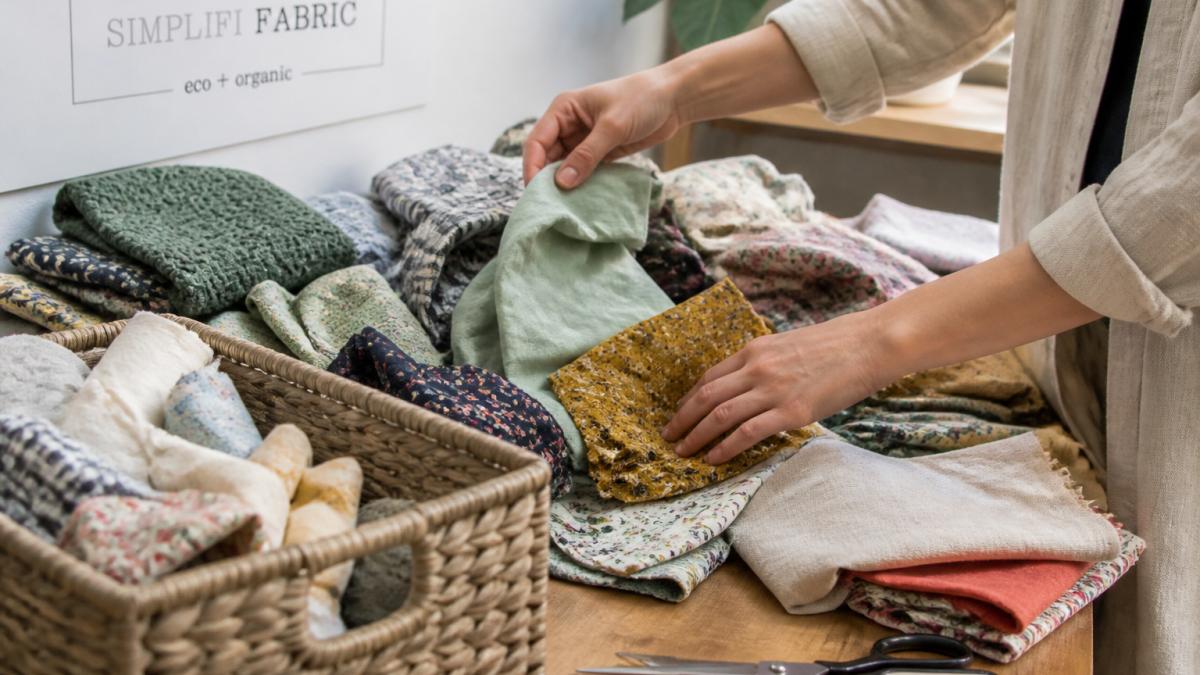
Thrift stores, estate sales, and online marketplaces offer affordable pre-owned fabric and garments suitable for deconstruction and reconstruction.
Upcycling requires creativity and problem-solving skills, rewarding makers with distinctive pieces. Constraints imposed by existing fabric dimensions encourage innovative pattern adaptation.
Sustainable sewing alternatives help makers create responsibly without compromising quality or design vision. Whether prioritizing GOTS-certified organic cotton, exploring regenerated fibers, or embracing upcycling, each approach reduces environmental impact while supporting ethical manufacturing practices. Simplifi Fabric's curated collection of organic fabrics, sewing patterns, and eco-friendly notions ensures that sewers can build an entire sustainable creative practice through a single trusted source.
Frequently Asked Questions
What is the most environmentally friendly fabric for sustainable sewing?
Organic cotton, hemp, and Tencel (Lyocell) are among the top sustainable fabrics identified for 2026. Organic cotton eliminates synthetic pesticides, hemp requires minimal water, and Tencel uses closed-loop production. However, pre-owned and upcycled textiles from thrift stores represent the most ethical choice, as they prevent existing materials from entering landfills while requiring zero new production resources.
How do I identify GOTS certified fabric when shopping for sustainable sewing supplies?
Look for the GOTS (Global Organic Textile Standard) certification label on product listings or fabric packaging. This certification verifies that organic cotton has been grown without synthetic pesticides and processed under strict environmental and social standards. When shopping for eco friendly quilting supplies online, reputable retailers clearly display certification credentials and provide links to verification databases, giving you confidence in the fabric's authenticity.
Are sustainable fabrics more expensive than conventional options?
Sustainable fabrics typically cost more per yard due to ethical production practices, smaller-scale manufacturing, and rigorous certification processes. However, their durability often justifies the investment, garments made from organic cotton, hemp, and linen outlast conventional alternatives, reducing the need for frequent replacement. Buying pre-owned textiles offers the most budget-friendly sustainable option while delivering the lowest environmental footprint.
What eco-friendly alternatives exist to plastic sewing notions?
Wooden and metal sewing tools replace plastic needles, bobbins, and rulers. Natural fiber buttons made from wood, coconut, or horn replace plastic alternatives. Biodegradable sewing thread options include those made from organic cotton or plant-based materials. These notions reduce your sewing project's environmental impact while often improving durability and providing a more tactile, satisfying sewing experience.
How can I verify a fabric retailer's ethical sourcing claims?
Check for third-party certifications like GOTS, Fair Trade, or B Corp status displayed on their website. Reputable retailers provide transparent supply chain information, naming manufacturers and production locations. Look for case studies or impact reports showing their commitment to environmental and labor standards. Read customer reviews and industry recognition. Avoid retailers making vague sustainability claims without verifiable credentials or specific sourcing details.