

Quick Summary
The right denim weight depends on the season, the use and the pattern style. Around 5oz suits relaxed or wide-leg trousers and warm weather, while midweight denim, roughly 8 to 10oz, is the most versatile choice for everyday straight or tapered trousers.
- Check the stated weight in oz or gsm, since category names are informal and vary by source.
- A 5oz denim weighs about 140gsm and suits relaxed or wide-leg trousers.
- Midweight denim holds a clean line and resists everyday wear reasonably well.
- Heavier denim is stiffer, takes longer to break in and needs careful seam handling.
- Prewash and test a 30cm square before cutting, since shrinkage can change the weight category.
Table of Contents
- How Denim Weight Is Measured and Why It Matters
- Lightweight Denim for Trousers: Drape, Comfort and Limits
- Midweight Denim for Pants: The Most Versatile Choice
- How Weight Affects Durability, Break-In and Fit
- Matching Denim Weight to Season, Use and Pattern
- Sewing Denim Trousers: Machine, Prewash and Stretch Considerations
- A Quick Denim Weight Guide for Your Next Pair of Trousers
- Frequently Asked Questions
How Denim Weight Is Measured and Why It Matters
Denim weight is the fabric's weight per unit area, usually stated in ounces per square yard (oz) or grams per square metre (gsm). A 5oz denim weighs about 140gsm. Knowing the number helps you predict how a finished pair of trousers will hang, feel and wear.
Weight categories are informal. Denim weight categories are not standardized, and different sources place the lightweight, midweight and heavyweight boundaries at different points. Treat the labels as rough guides and judge the fabric itself for the trousers you plan to make.
Weight matters because it changes almost everything about the finished garment. Heavier cloth is stiffer and more structured. Lighter cloth moves with the body and drapes more softly. Before you cut, decide which of those qualities your trousers need.
- Check the stated weight in oz or gsm on the fabric listing.
- Compare fabrics using the same unit, since conversions can be confusing.
- Treat category names as a starting point, not a rule.
Lightweight Denim for Trousers: Drape, Comfort and Limits
Lightweight denim is a good choice when you want trousers that feel relaxed and airy. The fabric softens quickly and drapes well, which suits wide-leg, relaxed or summer styles.
Simplifi Fabric carries a 5oz Cotton Dress Weight Denim in indigo blue and in black. Both are 100% cotton and 150cm wide, and both are listed as ideal for tops, dresses and lightweight trousers. Their listing notes that the fabric has a sheen that will be lost once washed and that it softens.

The trade-off is durability. A lighter cloth wears through faster at the knees, seat and pocket openings, especially with daily use. It also shows fine seam puckering more readily, so use a shorter stitch length and test on a scrap first.
Where lightweight denim works best:
- Relaxed or wide-leg trousers
- Warm-weather wear
- Trousers you plan to wear casually, not for heavy work
Midweight Denim for Pants: The Most Versatile Choice
Midweight denim sits in the middle of the range and suits the widest variety of trouser projects. It holds a clean line on a straight or tapered leg, resists everyday wear reasonably well, and still feels comfortable after a few washes.
Simplifi Fabric's Platano Banana Denim is 100% cotton at 310gsm and 160cm wide, and its listing describes it as a super soft denim with a good weight for trousers, boilersuits and jackets. Its Firle Floral Stretch Denim is 98% cotton with 2% elastane at 265gsm, listed as suitable for trousers and skirts with a bit light body or structure. For a comparison, a raw stretch denim gives you an unwashed option to set against the washed alternatives.
Many pattern listings also suggest midweight fabrics. The Jordan Overalls PDF pattern, for example, calls for light to mid-heavy weight woven fabrics such as wool, linen or denim. The Wide-Leg Jeans pattern from The Assembly Line recommends mid weight fabrics such as twill or denim.
Choose midweight when you want one fabric that works for most occasions.
How Weight Affects Durability, Break-In and Fit
Weight shapes how trousers behave over time. Heavier denim is more structured and tends to hold its shape. It also takes longer to break in, so the first few wears may feel stiff. Lighter denim softens sooner but may lose structure faster.
Fit is closely linked to weight. Stiff denim needs careful fitting at the waist and seat because it will not give much. Stretch denim adds comfort, but the listing for stretch denim describes it as suited to a bit light body or structure. Stretch percentage and weight should be considered together.
Two practical points help here:
- Expect break-in. Rigid, heavier denim often softens noticeably after several wears and washes.
- Mind the seat and crotch. Stiff fabric can restrict movement, so consider a slightly more generous fit in these areas.
Matching Denim Weight to Season, Use and Pattern
Most denim guides stop at "light for summer, heavy for winter." For handmade trousers, the decision is more specific: weight has to match the season you will wear the trousers in, the kind of use they will get, and the shape the pattern is drafted to create. Use the matrix below as a starting point, then adjust for the fabric in front of you.
5oz Cotton Dress Weight Denim - Indigo Blue - Merchant & Mills →
| Intended use | Suggested weight range | Why it works for trousers | Watch-outs |
|---|---|---|---|
| Warm-weather, relaxed or wide-leg | Around 5oz (about 140gsm) | Drapes softly, moves with the body, feels airy | Wears faster at knees, seat and pocket openings; shows seam puckering |
| Year-round everyday, straight or tapered | Roughly 8-10oz | Holds a clean line, resists daily wear, softens after a few washes | Needs a slightly more generous seat and crotch for movement |
| Structured, hard-wearing, workwear-inspired | Heavier bottomweights | Holds shape, takes abrasion, develops pronounced fades | Longer break-in, bulkier seams, harder on home machines |
| Stretch comfort pairs | Midweight with a small elastane percentage | Adds give and recovery for movement-heavy days | Recovery varies; test a washed seam before committing |
Season is the first filter. In warm weather, a lighter cloth keeps the trousers from feeling clammy and lets a wide leg drape instead of standing away from the body. In cooler months, a midweight or heavier cloth traps more air and holds a pressed line. If you want one pair to work across seasons, midweight is the safer compromise because it is structured enough for cool days and still softens enough for mild ones.
Use is the second filter. Casual everyday trousers can take a softer, lighter fabric because they are not subjected to repeated abrasion. Trousers for active or outdoor use benefit from more structure and abrasion resistance, which heavier cloth provides. Occasional-wear trousers can lean either way depending on whether you prioritize drape or longevity.
Pattern style is the third filter, and it is where handmade makers have an advantage over ready-to-wear shoppers. A relaxed or wide-leg pattern can carry lighter denim because the extra volume lets the fabric fall into the shape rather than cling. A slim or tapered pattern usually looks better in a fabric with more body, because a soft cloth can collapse at the knee and lose the intended line. Heavier weights ultimately provide a more robust structure that resists the stresses of daily wear, a reality grounded in the science of fabric durability.
A practical way to decide: hold the fabric up against the pattern piece. If it flops and collapses when you lift it by one corner, it will likely suit a relaxed shape. If it holds a fold on its own, it will support a structured or tapered leg. That quick check tells you more about how the finished trousers will behave than the ounce rating alone.
Sewing Denim Trousers: Machine, Prewash and Stretch Considerations
Weight changes how denim behaves under the needle, and that is where handmade trousers differ most from ready-to-wear. A fabric that sews easily as a flat swatch can become a fight at the waistband, fly and hem, where several layers meet. Plan the construction around the weight before you cut.
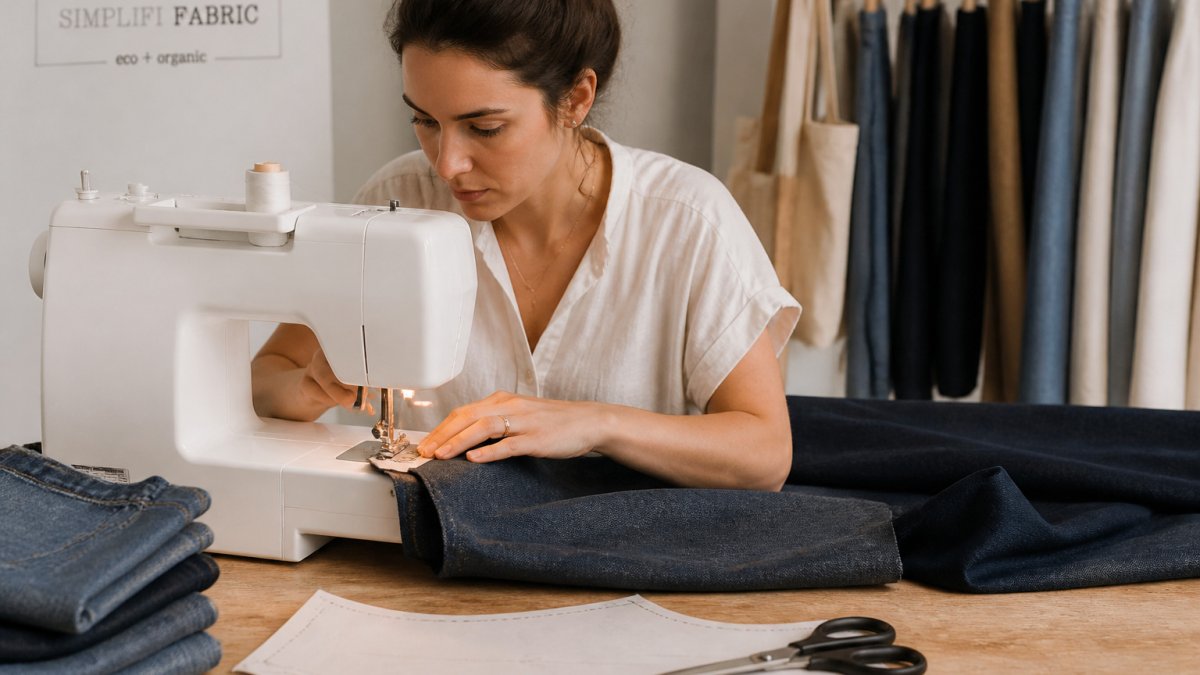
Prewash first, and prewash realistically. Denim can shrink, and a large piece of medium-heavy denim can develop white creases in the washing machine because the stiff fabric has little room to move. Break the fabric into smaller pieces or wash it on its own, then iron while still damp if creases appear.
Match needle, thread and presser foot to weight. For lightweight denim, a standard or slightly heavier universal needle and a fine-to-medium thread reduce seam bulk and puckering; a shorter stitch length helps control fine seam puckering. For midweight, a denim or jeans needle in the 90/14 to 100/16 range and a medium thread handle most seams.
Manage seam bulk where it matters. The waistband, fly, side seams and hem are the pressure points. On heavier denim, grade and trim seam allowances, press them open or to one side as the pattern directs, and consider a hammer or clapper to flatten thick intersections before topstitching. On lighter denim, the risk is the opposite: too much handling can distort the seam, so test stitch length and tension on a scrap first.
Plan the hem and topstitching for the weight. Heavier denim needs a longer stitch and a heavier topstitching thread to read as a deliberate finish; lighter denim looks better with a finer topstitch and a narrower hem. Always test the topstitch on a folded scrap of the actual fabric, because the same settings that look clean on midweight can tunnel or skip on heavy layers.
Treat stretch denim as its own problem. Elastane adds give but can change the fit after washing, and recovery varies by blend. Sew a test seam, wash it, and check whether it returns to its original length before you rely on it for a fitted waist or seat.
A simple rule: the heavier the denim, the more you should test, grade, press and slow down. The lighter the denim, the more you should control stitch length and handling to avoid distortion.
A Quick Denim Weight Guide for Your Next Pair of Trousers
Use this checklist to narrow your choice before you buy:
- Lightweight (around 5oz): Relaxed or wide-leg trousers and warm weather. Expect faster wear and softer structure.
- Midweight (around 8 to 10oz): Straight, tapered or everyday trousers. A safe all-round choice.
- Heavier fabrics: Structured, hard-wearing trousers. Expect longer break-in and more care when sewing.
- Stretch: Choose a blend when comfort and movement matter most, and check how the fabric recovers after washing.
Before you buy, prewash a small swatch, check the weight in oz or gsm, and consider the season and the pattern style. For a fabric that suits most handmade trousers, shop the midweight options and lightweight denims at Simplifi Fabric, which ships worldwide from Ontario and carries indie sewing patterns and notions to match your project.
Frequently Asked Questions
What denim weight is best for handmade trousers?
For most handmade trousers, a midweight denim in the 12 to 14 oz range is the most practical choice. It holds a crisp line, resists wear and is still manageable on a home sewing machine. Lighter fabrics suit relaxed or summer styles, while heavier denim suits workwear and structured fits. Check the fabric's weight in grams per square metre or ounces per square yard on the listing before you buy, since category names vary between suppliers.
Is 12 oz denim too heavy for trousers?
No. Twelve ounce denim is widely used for trousers and sits at the lighter end of the midweight range. It drapes more than heavier denim while keeping enough body to hold its shape through the day. Whether it feels too heavy depends on climate and fit. For warm weather or very slim trousers, a lighter fabric may be more comfortable.
Can you use stretch denim for handmade trousers?
Yes, but choose stretch denim deliberately. A small percentage of elastane, such as the 2 percent blend in some printed stretch denims, gives comfort and easier movement without much change in structure. Stretch fabrics can distort during cutting and sewing, so use a stable seam and test the fabric before cutting the full pattern. Patterns written for non-stretch woven fabric often need adjusting for stretch denim.
How much denim do I need to make a pair of trousers?
Yardage depends on the pattern, the view you choose, the fabric width and your size. Pattern envelopes and listings typically list requirements for 110 to 150 centimetre widths. Wider fabric generally reduces the length you need. Buy a little extra for prewashing shrinkage, and buy the fabric in the same weight and width the pattern specifies.
